


Learning objectives :
- Use a structured approach to provide constructive feedback, whether it’s for development or recognition
- Doing it at the right time and using the right wording
- Incorporating feedback into your management routines without expending too much energy
Course :
Session 1: Structuring Feedback
Giving useful feedback isn’t intuitive. Participants learn to structure their feedback using the COIN method: Context (at such-and-such a time...), Observations (I noticed that...), Impact (this is important because...), Next Steps (what do you think? How can I help you?). The method works equally well for both developmental and recognition-based feedback. Participants also work through a checklist of common pitfalls to avoid, so as not to fall into vague phrasing, generalizations, or value judgments.
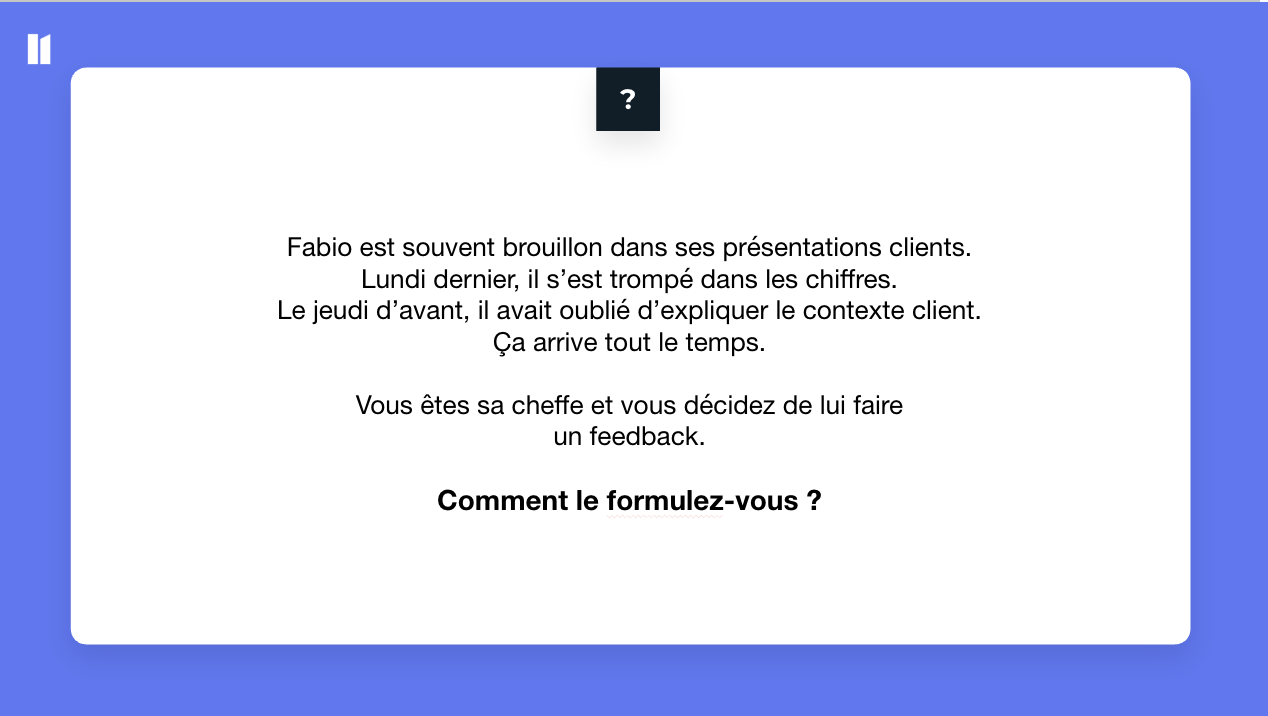
Case Study : Role-play with peers to simulate real-life management situations, gain awareness of pitfalls to avoid, and walk away with concrete, ready-to-use phrases.
Session 2: Peer Feedback
Feedback doesn’t just flow from manager to employee. Participants learn to give and receive feedback in both directions and in a 360-degree format using the Start/Stop/Continue matrix: what to keep doing, what to stop doing, and what to start doing.
Case Study : Practice giving and receiving peer feedback using the Start/Stop/Continue matrix, focusing on providing specific and actionable feedback.
Session 3: Incorporating Feedback into Your Routines
A single instance of feedback has little impact. This session equips participants to make feedback a regular managerial habit without it becoming time-consuming. Three tools guide the sequence: a feedback log to identify the moments when feedback is most useful, key phrases to offer it naturally in daily interactions, and standard phrases to address sensitive situations without either avoiding or overcomplicating the message.
Case Study : Use the logbook to track your feedback moments throughout the week, and work on finding the right wording for sensitive feedback that you might otherwise avoid giving because you can’t find the right words.
When you leave this workshop, you'll know...
- Provide clear and actionable feedback, whether for development or recognition
- Choosing the right time and the right words, including when giving sensitive feedback
- Incorporate feedback into your daily routine—regularly and without spending too much time on it
And it'll come in handy for...
- Help your employees grow
- Engaging them on a daily basis and over the long term


.png)


.png)
.png)


