

.png)

Learning objectives :
- Work closely with your direct report to prepare their individual performance review
- Adopting the right posture during a meeting based on your colleague’s role and seniority
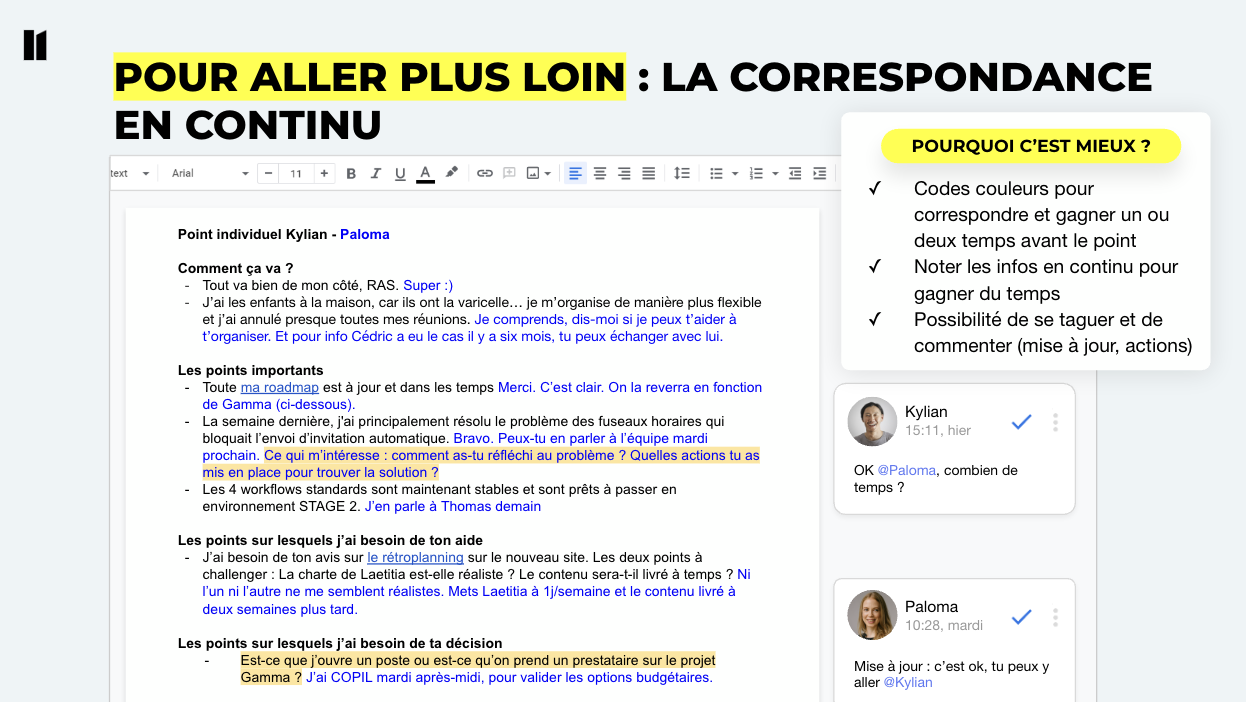
- Use asynchronous communication to improve the quality of interactions and ensure continuous communication
Course :
Session 1: Before the Meeting: Preparation
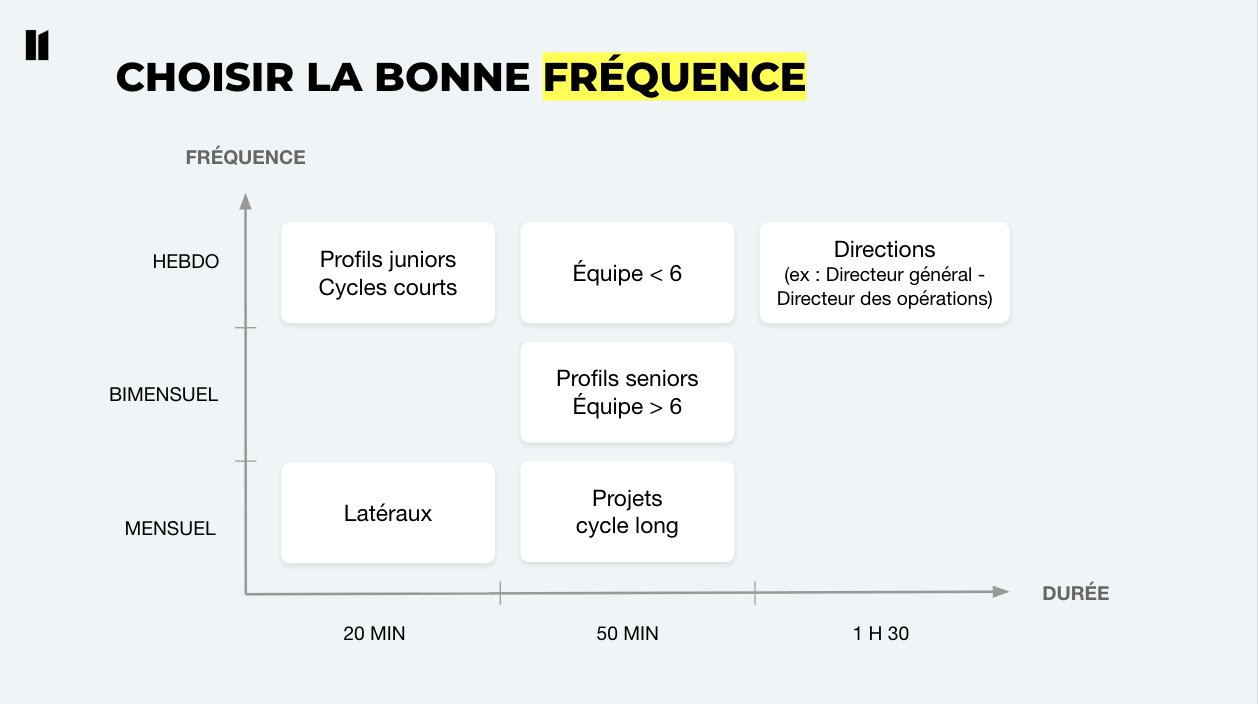
Even before the meeting begins, everything hinges on preparation. Participants learn how to schedule their one-on-ones at the right time and how to define an agenda structure tailored to their employee’s role and seniority. Two tools are central to this sequence: the Frequency Matrix to determine the appropriate frequency of check-ins, and a ready-to-use agenda template.
But the challenge doesn't end with the manager's preparation. Participants practice handing this responsibility over to the employee, turning them into an active participant in the discussion rather than a mere observer.
Example scenario : Coaching an employee on the 1:1 agenda they proposed, to help them structure and prioritize their own topics.
Session 2: During the Meeting
Once the meeting is underway, the key is to speak sparingly and listen attentively. Participants work on adapting their approach based on the profile of the person they’re speaking with through two distinct scenarios: with a junior colleague and with a senior colleague. They practice managing through questioning, providing feedback at the appropriate level, and keeping the 1:1 conversation on track even when it seems to stall.
Case Study : adapting your approach and questions when dealing with a junior candidate on one hand and a senior candidate on the other, so that in both cases you arrive at concrete actions that are easy to follow over time.
When you leave this workshop, you'll know...
- Delegate the preparation of individual agenda items to your direct reports to empower them and improve the quality of discussions
- Adjust your body language during the meeting to listen attentively, ask thoughtful questions, and provide helpful feedback
- Use asynchronous communication to maintain continuous communication between nodes
And it'll come in handy for...
In hierarchical management:
- See how things are going and build a lasting relationship of trust
- Challenge your direct reports’ priorities in light of the strategy
- Provide assistance or coaching when someone is stuck
In cross-functional management:
- Identifying bottlenecks in a project
- Maximizing the engagement of a key contributor
- Building trust in an ad hoc working relationship


.png)


.png)


.png)
.png)


