


Learning objectives :
- Prepare for negotiations systematically by defining your range of acceptable terms, your concessions, and your Plan B
- Confidently express your position and identify the real issues by asking open-ended questions
- Build a solid agreement by making gradual concessions and ensuring the deal is sealed
Course :
Session 1: Preparation
Participants learn that effective negotiation requires the same preparation as a sales pitch, consisting of five key elements: identifying both parties’ objectives and a realistic vision of success, defining one’s stated position (which must be 5 to 10% above one’s actual objective), preparing 2 to 3 arguments that legitimize this position, anticipating common objections, and preparing concessions along with corresponding give-and-takes, as every concession must be accompanied by a request in return.
They also work on the BATNA (Best Alternative to a Negotiated Agreement): identifying their own Plan B and that of the other party, as this is what determines each party’s negotiating stance and their true room for maneuver. Putting it into practice: preparing for a multi-variable SaaS negotiation (number of users, contract duration, support, price) by defining objectives, the range of possible agreement, stated positions, and concessions.
Sequence 2: Stating Your Position and Analyzing the Issues
Participants first learn about the two mistakes that undermine credibility within the first few seconds: not being comfortable with your proposal (hesitating, describing your price as “a preliminary estimate”) and offering a concession right off the bat, which immediately signals that the true price was lower. They learn to state their position first, to handle silence without filling it with assumptions, and to explicitly address a nonverbal reaction from the customer.
The second part focuses on problem analysis: participants work on two common pitfalls (arguing the merits of an issue without asking questions, or asking closed-ended questions that don’t open up the discussion) and practice asking open-ended questions to uncover the real issue behind a statement like “it’s too expensive.” They practice rephrasing before arguing and using the other person’s exact words to show that they have truly understood before responding.
Session 3: Reaching an Agreement and Closing the Deal
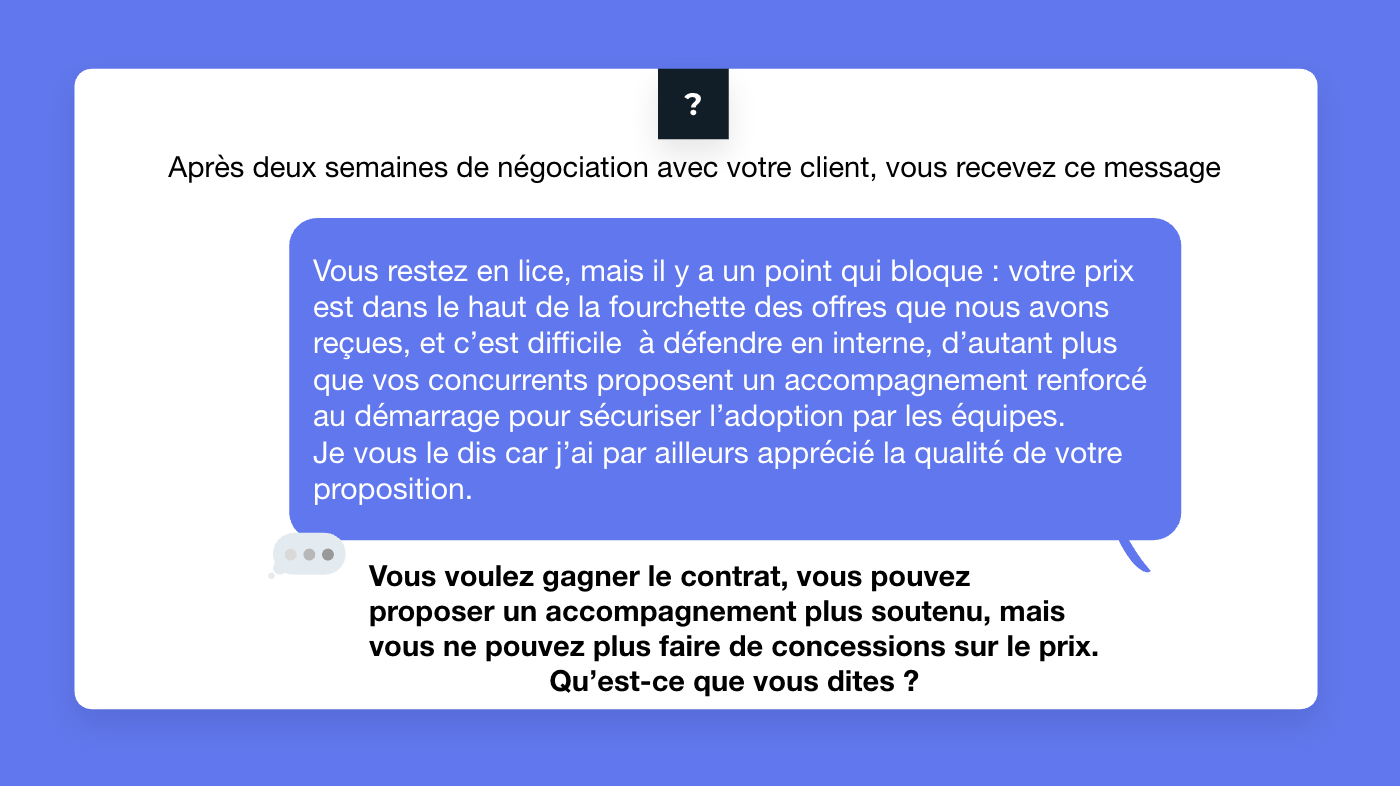
The third session focuses on the art of making concessions: never make a concession right off the bat; reaffirm the strengths of your proposal before each concession; never make a major concession (use a gradual approach: 5%, then 7.5%, up to a maximum of 10%); and always turn a concession into an opportunity for a reciprocal offer. Participants then practice a final negotiation scenario. The session concludes with a role-playing exercise in pairs, with two distinct positions (supplier and client) in a multi-variable negotiation, an observer-coach who notes strengths and moments of weakness, followed by a group debrief.
Participants learn how to close a deal systematically: saving their final concession as a last resort, objectively assessing whether there are any obstacles to reaching an agreement, and never improvising a counteroffer under pressure.
When you leave this workshop, you'll know...
- Preparing for a negotiation systematically
- Confidently articulate your position and handle sales discussions with ease
- Build a solid agreement by making gradual concessions
And it'll come in handy for...
- Negotiating beyond price: timing, volume, scope, support, or terms of collaboration
- Approach every negotiation with a calm and structured mindset, regardless of the pressure from the client






.png)


.png)
.png)


